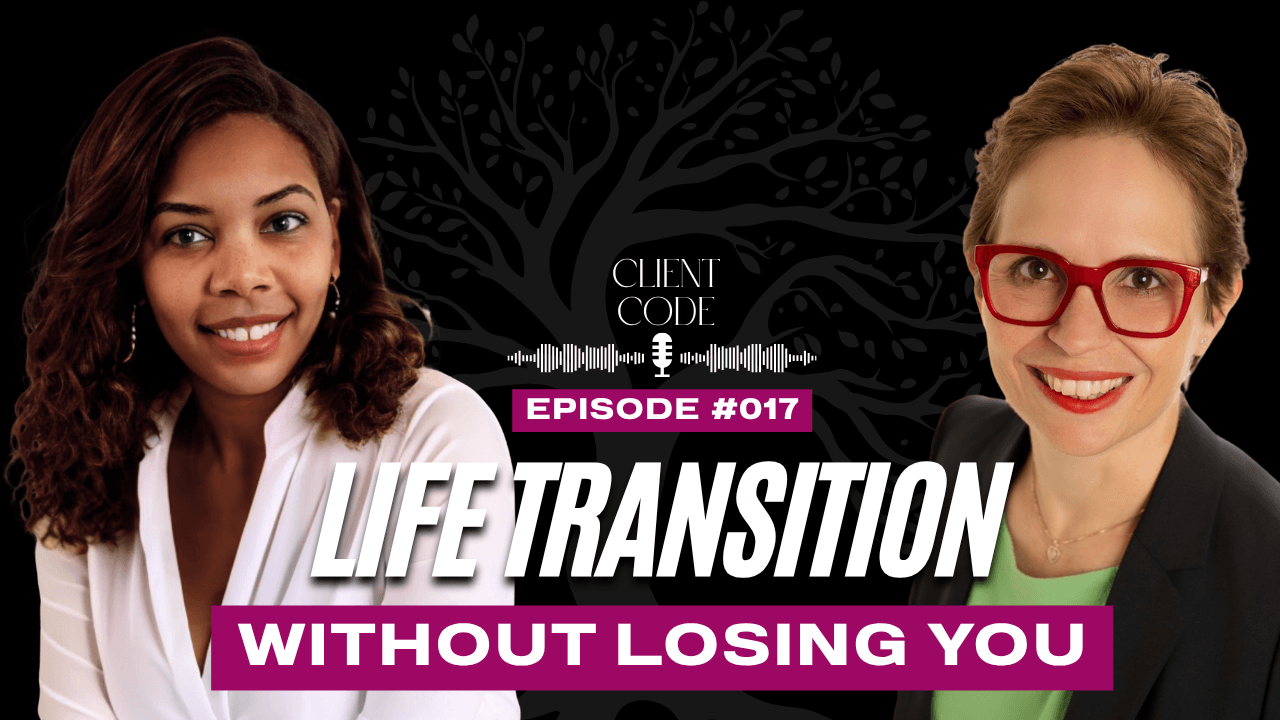
Guys, you need to hear this.
Rachel asked me a question in this episode that I have not stopped thinking about. She said most people who come to her are only 20 to 40 percent happy in their jobs. Then she asked: would you stay in a marriage that was 60 percent not working? Would you drive a car that was 60 percent falling apart?
No. No, you would not. So why do we accept that from our careers?
Rachel helps high-performing professionals who are stuck in soul-sucking careers move to soul-aligned work and still make a great income. She is a therapist by training turned career coach, which means when you work with her, you are not just getting job advice. You are getting someone who understands why you are stuck, not just where.
She used me as the guinea pig during our conversation, and I have to say, being coached live on your own podcast is humbling. But the insights she pulled out? They apply to every single person listening.
The Three C's You Need to Feel Alive at Work
Rachel had me walk through my ideal morning, the slow start, the gym, the coffee before opening emails. And then she mirrored back what she heard: I need spaciousness, autonomy, and time to myself before I can be productive. She was dead right.
Then she introduced what she calls the three C's: community, contribution, and challenge. These are the three things that make you feel connected to your work. If your job is not giving you at least one of them, that is why you are checked out during meetings and dreading Monday mornings.
"What are the values that you know you need to bring to work or to your life? And how does work fit into those?"
Here is what I love about Rachel's approach: she is not telling you to quit tomorrow. She is asking you to start noticing. What lights you up? What drains you? She even gave a homework exercise. Write down every professional task you did in the last 48 hours, how much time you spent on each, and how much you enjoyed it. That is data. And data does not lie.
The minute you start seeing that you are spending 80 percent of your time on tasks you hate, you have got your roadmap for change.
Do Not Quit Like I Did (Please)
I am not even going to lie to you. I told Rachel that I quit my corporate job nine years ago with zero plan. No savings cushion, no side hustle lined up, no five-year projection. Just vibes and a vision that I did not want to work until nine at night anymore.
Rachel's response? "That is exactly what I do not advise doing."
I felt that. And she is right. It worked out for me, but there was debt, there was stress, and there was a lot of figuring it out the hard way. Rachel left her career with a five-year financial plan. She researched programs, understood her market, talked to other coaches doing similar work, and calculated the risk before she took the leap.
"People say, oh my gosh, you took so much risk. It was a calculated risk. It was a well-researched risk. What is scariest is that you are risking it on yourself."
That last part hit me. The risk is not really the money or the job title. It is betting on yourself. And that is where all the fear and self-doubt lives.
For anyone sitting in a job that is draining them: you do not have to do what I did. Know your two or three reasons for staying, money, routine, insurance, acknowledge them without shame, and then start building your exit plan with intention. Research who is doing what you want to do. Understand your financial projections. Meet with people in the field. Reverse engineer the career you actually want.
Write Your Own Mission Statement (Yes, You)
Here is the part that really got me, and honestly, I am doing this today. Rachel said every company on the planet has a mission statement, so why do you not?
"Create your own professional mission statement. Put it on your LinkedIn, put it on a business card, and start attracting all of that."
It is like a billboard for what you will and will not stand for. This is who I am, this is what I bring, this is who I help. Do you match? No? Goodbye, there is someone else out there who does.
The formula is simple: I help [these people] do [this thing] by doing [this thing]. Rachel has hers printed out and pinned up where she can see it every day. I told her on air that I am going home to do the same thing. And I meant it.
For founders especially, this is everything. Your mission statement is not just for your business. It is for you. It clarifies your decisions, filters your opportunities, and keeps you from chasing every shiny object that comes your way.
Quick Takeaways
- Track your last 48 hours. Write down every professional task, the time you spent on it, and your enjoyment level. The gaps between time and enjoyment are your roadmap for change.
- Check your three C's. Community, contribution, and challenge. If your job is not giving you at least one, that is why you are disconnected. A free visibility audit can help you see where you stand.
- Do not quit without a plan. Know your reasons for staying, calculate your financial runway, research your market, and build your exit with intention.
- Write your own mission statement. Use the formula: I help [these people] do [this thing] by doing [this thing]. Put it everywhere.
- Your career is not a life sentence. There is a reason, a season, or a lifetime for every job. Give yourself permission to recognise which one you are in.
What You Do Not Change, You Choose
When I asked Rachel what she is choosing, her answer was one word: intentionality. In a world that is noisy, full of emails and distractions, she is choosing to focus on her two to three highest priorities and letting everything else become secondary, and being comfortable with that.
I love that. Everything else is noise. Let us be intentional and move the needle forward. If you want a steady hand on the strategy side as you make your move, you can always book a strategy call.
"People say, oh my gosh, you took so much risk. It was a calculated risk. It was a well-researched risk. What is scariest is that you are risking it on yourself."